A ship can be thousands of kilometers from its home port, but a surprisingly small component can bring an entire operation to a standstill. A failed controller, obsolete interface module or unavailable actuator may look insignificant on a parts list. Onboard, however, it can become a serious operational headache.
That is why buying the right remote control system spare parts is about much more than finding something with a similar-looking label. Shipowners, operators, fleet managers and marine engineers need to consider compatibility, availability, documentation, condition and the operating environment. For businesses looking for specialist marine components, you can explore marine automation and control system spare parts before contacting a supplier for specific requirements.
A reliable remote control system connects the operator with critical machinery and propulsion functions. When a component fails, speed matters — but accuracy matters even more.
What Is a Marine Remote Control System?
A marine remote control system allows operators to control or monitor machinery from a designated control position rather than operating every function directly at the equipment itself.
On a conventional vessel, this may involve propulsion controls, engine speed, clutch or gearbox commands, alarms, indicators and related safety functions. More sophisticated systems can integrate with wider marine automation systems and ship automation equipment.
The terminology can vary between manufacturers. You may encounter marine propulsion remote control, ship engine remote control system, vessel remote control system or marine machinery control systems. While these terms overlap, the exact architecture depends on the vessel, machinery and control philosophy.
The important point is that the system is not simply a remote button panel. It is part of a wider chain connecting operator commands, controllers, sensors, actuators and machinery.
Why Spare Parts for Ships Are Different
Buying ordinary industrial electronics is not the same as sourcing marine control system components.
Marine equipment operates in an environment where vibration, temperature changes, humidity, salt exposure and continuous operation can all matter. Components may also need to interface with equipment installed decades earlier, creating compatibility challenges that would rarely appear in a standard land-based application.
This is why a ship control system parts catalogue can contain everything from switches and relays to electronic modules, controllers, sensors, interface boards and specialized communication components.
A visually identical replacement is not necessarily an electrically or functionally compatible replacement. That distinction can save — or cost — a lot of money.
The Main Components You May Need
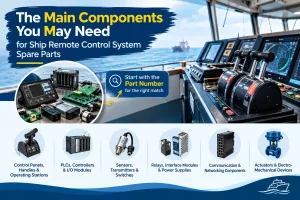
When sourcing remote control system spare parts, begin by identifying exactly where the failed or ageing component sits within the control architecture.
For example, an operator station may contain control handles, push buttons, displays and indicators. The control cabinet may contain PLCs, interface modules, relays, power supplies and communication equipment. Further down the chain, sensors and actuators interact directly with engines, propulsion equipment or other machinery.
Common categories include:
- Control panels, handles and operating stations
- PLCs, controllers and I/O modules
- Sensors, transmitters and switches
- Relays, interface modules and power supplies
- Communication and networking components
- Actuators and electro-mechanical control devices
The exact part required depends on the manufacturer’s system, vessel configuration and application. That is why the part number should normally be your starting point rather than a generic product description.
How to Identify the Correct Remote Control System Part
The fastest way to find a replacement is usually to gather as much information as possible before contacting a supplier.
Look for the manufacturer’s name, model number, serial number, part number and revision information. Photographs of the component label and its installation can also be extremely useful, particularly when documentation is incomplete.
If the original manual is available, check the parts list and system drawings. Wiring diagrams can reveal whether a component is part of a larger assembly rather than a standalone replacement.
For older vessels, this research becomes even more important. A ship engine remote control system may have been modified several times during its operational life, so the equipment currently installed may not perfectly match the vessel’s original documentation.
OEM Parts vs Compatible Alternatives
One of the biggest decisions when sourcing marine control equipment is whether to buy an original manufacturer component or a compatible alternative.
OEM parts can offer a straightforward path when the original manufacturer still supports the system. You generally have clearer traceability and confidence that the component was designed for that equipment.
However, older vessels can present a different problem. An OEM component may be discontinued, have a long lead time or carry a significant price premium. In those situations, a professionally assessed alternative, refurbished unit or surplus original part may be worth investigating.
The key is not to assume that “compatible” means “close enough”. The replacement should be technically evaluated against the original specifications, interface requirements and operating conditions.
New, Refurbished or Used Marine Spare Parts?
The condition of a component should be considered alongside urgency, budget and criticality.
New parts are usually the simplest choice where availability and cost are reasonable. Refurbished parts can be useful for legacy equipment, particularly when an original component is no longer manufactured. Used components may also provide a practical solution for older systems, but their history and condition need careful consideration.
For a non-critical display or obsolete interface module, a verified refurbished component might make commercial sense. For a safety-critical application, however, traceability, testing, certification and suitability should receive much greater attention.
A good marine spare parts supplier should explain the condition of the item clearly instead of leaving you to decode vague phrases such as “tested” or “good working condition”.
Remote Control System Compatibility Checklist
Before ordering, compare the replacement against the installed component rather than relying on appearance.
Important information can include the manufacturer’s part number, electrical ratings, communication protocol, software or firmware requirements, connector configuration and physical dimensions. For programmable equipment, version compatibility can be just as important as the hardware itself.
| Check | Why it matters |
| Part number | Confirms the intended component |
| Manufacturer and model | Helps establish system compatibility |
| Revision or firmware | Prevents software-related conflicts |
| Voltage and electrical ratings | Ensures safe operation |
| Connector and interface | Confirms physical and electrical fit |
| Certification/documentation | Supports traceability and compliance |
| Condition | Establishes whether the part is new, refurbished or used |
This simple comparison can prevent a classic marine procurement problem: receiving a component that looks right, costs money and still cannot be installed.
Finding Spare Parts for Older Ship Systems
Legacy equipment is where sourcing expertise becomes particularly valuable.
Many vessels continue operating with control systems that are no longer manufactured. The original supplier may have discontinued a controller, replaced an entire product family or stopped supporting an older generation of equipment.
That does not automatically mean the vessel needs a complete modernisation.
A specialist supplier may be able to locate obsolete stock, reconditioned components, surplus inventory or suitable replacement assemblies. In some cases, engineers can also identify a newer equivalent, but that should be treated as an engineering decision rather than a simple purchasing substitution.
For older marine automation systems, documentation is gold. A faded label or an old manual can sometimes be more valuable than a generic online search.
Marine Propulsion Remote Control Requires Extra Care
Propulsion control deserves particular attention because it directly affects vessel manoeuvrability and engine operation.
A marine propulsion remote control arrangement may involve bridge controls, engine-room controls, local control stations, governors, gearboxes, clutches, sensors and safety interlocks. A problem in one part of this chain can affect the behaviour of the entire system.
When sourcing propulsion-related marine engine control system components, do not treat the task as ordinary electrical procurement. The replacement needs to fit the actual control philosophy and machinery configuration.
This is also why troubleshooting should precede ordering whenever practical. Replacing an expensive controller when the real problem is a sensor, wiring fault or power supply can turn a technical issue into an unnecessary procurement bill.
Remote Control System and Marine Automation
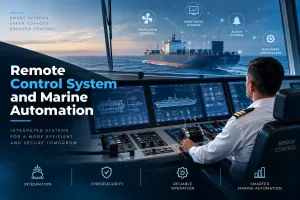
Modern ships increasingly depend on integrated automation. A remote control system may communicate with monitoring platforms, alarm systems, machinery controllers and other onboard systems.
The International Maritime Organization recognizes that increasing digitalisation, integration and automation introduce cybersecurity considerations alongside operational benefits. Its maritime cyber-risk guidance covers the need to identify, assess and mitigate risks affecting shipboard technology.
That means replacement parts should not be evaluated solely on whether they make the machinery operate. Network connectivity, configuration, access controls and software dependencies may also matter.
For connected equipment, changing a component can have consequences elsewhere in the system. Always follow the manufacturer’s procedures and the vessel’s established maintenance and cybersecurity processes.
How to Choose a Marine Spare Parts Supplier
A dependable supplier should be able to do more than send you a price.
The best suppliers ask questions. What vessel is the component for? What system is installed? What is the exact part number? Is the equipment still operational? Is the replacement urgent? Do you need new, refurbished or used stock?
That conversation matters because marine spare parts often have complicated histories. A component may have several revisions, replacement part numbers or manufacturer equivalents.
A specialist supplier should also communicate lead times and condition honestly. If an item is obsolete, say so. If it is refurbished, explain what testing or inspection has been performed. If documentation is limited, make that clear before the purchase.
Sacred International supplies marine automation and electrical spare parts and can assist buyers looking for components for shipboard automation and control applications. A specialist supplier can be particularly useful when standard distributors no longer carry legacy equipment.
Questions to Ask Before Buying
Before approving a purchase, take a few minutes to confirm the technical and commercial details. It can save days of avoidable back-and-forth later.
Ask whether the supplier can confirm the exact part number, whether the item is new or refurbished, what documentation is available and whether the supplier can provide photographs before shipment. If the part is critical to vessel operation, also clarify availability, delivery options and return conditions.
You should also establish whether the component is a direct replacement or an alternative requiring engineering review. Those two situations are very different, even if the price looks similar.
Avoiding Common Marine Spare Parts Buying Mistakes
One of the most common mistakes is ordering from a keyword alone. Searching for “marine controller” or “engine remote control” can produce hundreds of components that have nothing to do with your specific installation.
Another mistake is ignoring revisions. Two components can share a product family name while having different electrical interfaces, firmware or communication capabilities.
Then there is the emergency purchase. When a vessel is waiting for a component, procurement teams naturally want the fastest option. But rushing without verifying compatibility can create an even bigger delay when the wrong part arrives.
The better approach is simple: identify first, verify second, order third.
Reducing Vessel Downtime Through Better Parts Planning
The smartest ship operators do not wait until a critical component fails before thinking about replacement availability.
For frequently used or difficult-to-source components, maintaining a small inventory of strategic spares can reduce downtime. The right inventory depends on the vessel, equipment age, failure history, supplier lead times and operational profile.
A remote control system supporting critical machinery deserves particular attention when parts have long lead times or are obsolete. Holding every possible component would be expensive and impractical, but identifying genuine single points of failure can make spare-parts planning much more effective.
A simple criticality assessment can separate “must have onboard” components from parts that can be sourced quickly from a regional or global supplier.
What Makes a Good Replacement Strategy?
A strong replacement strategy combines technical accuracy with commercial practicality.
For newer vessels, the priority may be maintaining OEM continuity and warranty support. For older vessels, availability and lifecycle support may become more important. For globally trading ships, supplier location and delivery capability can also influence the decision.
The right answer therefore changes from vessel to vessel.
A good procurement team considers the complete lifecycle rather than simply asking, “How much does this part cost?” The better question is, “What is the cost of not having the right part when we need it?”
That shift in thinking can transform spare-parts purchasing from reactive firefighting into proper operational planning.
The Future of Ship Remote Control Systems
Remote and automated vessel technologies are continuing to develop. The IMO adopted a non-mandatory International Code of Safety for Maritime Autonomous Surface Ships in May 2026, which entered into effect on 1 July 2026. The framework addresses ships using varying degrees of autonomous or remote technologies and emphasises risk assessment and human oversight.
That does not mean every conventional cargo ship is suddenly becoming autonomous. Far from it. But it does show where marine control technology is heading: more integration, more data, more automation and increasingly sophisticated interfaces between people and machinery.
For shipowners, that makes lifecycle planning even more important. Today’s spare-parts decision can influence tomorrow’s maintenance strategy, system compatibility and upgrade options.
Conclusion
Finding the right remote control system spare parts is ultimately a combination of technical identification, compatibility checking, supplier reliability and forward planning. Start with the exact part information, understand how the component fits into the vessel’s control architecture, compare OEM and verified alternatives carefully, and pay particular attention to legacy equipment. For critical systems, documentation, testing, traceability and lifecycle support should carry as much weight as price.
If you need help locating marine control system components, obsolete automation equipment or propulsion-related spares, speak with a specialist rather than gambling on a generic replacement. Sacred International can help businesses source marine automation and electrical spare parts for demanding shipboard applications. Visit the marine spare parts and automation solutions page to explore available equipment or contact the team with your vessel and part details for a tailored quotation.
FAQs
1. What is a remote control system on a ship?
A remote control system allows operators to control or monitor machinery from a location away from the machinery itself. Depending on the vessel, it may control propulsion, engine functions, alarms, clutches, gearboxes and related equipment through controllers, sensors and actuators.
2. How do I identify the correct spare part?
Start with the original manufacturer’s name, exact part number, model, serial number and revision information. Photographs, equipment manuals and wiring diagrams can also help a supplier verify compatibility. For obsolete equipment, provide as much system information as possible rather than relying on a generic description.
3. Should I buy OEM or refurbished marine control parts?
It depends on the equipment, criticality, availability and budget. OEM parts are often the simplest choice when available, while verified refurbished or surplus original components can be useful for legacy systems. Critical applications require particularly careful attention to testing, documentation and suitability.
4. Can an obsolete ship control component be replaced with a newer model?
Sometimes, but not automatically. A newer component may have different interfaces, firmware, communication protocols or electrical characteristics. An engineering assessment should confirm whether it is a genuine direct replacement or requires modification and system integration.
5. What marine equipment commonly uses remote control?
Remote control technology can be used with propulsion systems, engines, gearboxes, clutches, valves, pumps and other machinery. The exact application depends on the vessel’s automation architecture and the manufacturer’s system design.
6. Why should I use a specialist marine spare parts supplier?
Specialist suppliers can be particularly valuable when equipment is obsolete, difficult to identify or no longer supported by normal distribution channels. They may have access to new, surplus, refurbished or used components and can help verify part numbers before purchase.