
Introduction
A ship’s alarm panel can look quiet for hours, then suddenly fill with warnings when a generator changes load or a pump starts. Alarm monitoring systems are expected to sort that disturbance into useful information: what happened, where it happened, and whether the crew needs to act.
The difficult part is not producing an alarm. It is about making sure the alarm reflects the actual condition. A faulty transmitter can report a high temperature when the machinery is normal. A loose terminal can create an intermittent signal. A communication fault can make several unrelated alarms appear within seconds.
Testing needs to go beyond confirming that a message appears on the screen. When an alarm behaves unexpectedly, the useful question is where the information first becomes wrong. Reliable marine alarm monitoring equipment depends on accurate readings reaching the monitoring interface without distortion from a faulty connection or incorrect configuration. This approach helps engineers feel confident in their ability to identify issues accurately.
How Alarm Systems Track Conditions
Take a generator cooling-water circuit. The temperature transmitter may be working correctly, but a damaged cable can distort the signal before it reaches the input module. The controller then receives the wrong value and sends an alarm that looks completely legitimate on the screen.
The reverse can happen too. The field signal may be correct, while the operator interface displays the wrong equipment tag due to a configuration error. In that situation, replacing the transmitter would solve nothing.
The difference between the physical reading and the displayed value is often the first useful clue when checking alarm monitoring systems. That mismatch gives the engineer a reason to check the measurement and control side before treating the machinery itself as faulty.They may result from a normal transient, an unsuitable delay, an incorrect threshold, a communication interruption, or a genuine equipment condition. Reducing the number of alarms on the screen should not be the objective by itself.
Ship Alarm System Testing In Practice
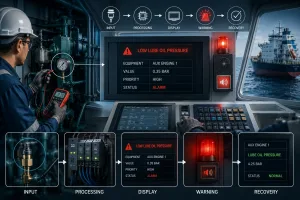
A ship alarm system testing routine should simulate the alarm condition without deliberately placing working machinery in an unsafe state. The test method should come from the equipment documentation and vessel procedures, particularly for alarms connected to shutdowns or protective functions
Consider a low-lubricating-oil-pressure alarm on an auxiliary engine. An engineer should not simply wait for the pressure to fall during operation. The approved test method can simulate the relevant input, after which the team checks whether the correct alarm appears, whether the audible indication operates, and whether acknowledgement and reset behave as expected.
During alarm monitoring systems testing, engineers need to verify that the alarm response matches the simulated condition and the indication expected by the crew. Check the response at the input, the information shown on the display, the warning output, and the behaviour after the test condition is removed.
Input: Confirm that the sensor or switch produces the expected signal.
Processing: Check that the correct input channel receives and recognises it.
Display: Verify the equipment name, value, priority and alarm status.
Warning: Confirm that the required audible or visual indication operates.
Recovery: Remove the test condition and check that the alarm returns to normal.
A delay during alarm monitoring system testing should also be recorded. If the input changes immediately but the alarm appears later on the operator display, the engineer has reason to investigate the control or communication side rather than replace the sensor without further checks.
Reading Alarm Behaviour Before Fault Finding
The order in which alarms appear can tell an engineer more than the alarm text itself. This is particularly useful when several warnings arrive almost together. Recognizing these patterns helps engineers feel more prepared and confident in diagnosing complex issues.
Imagine a vessel transferring electrical load between generators. The monitoring station suddenly reports alarms for generator status, communication, and auxiliary equipment within a few seconds. Treating each message as an independent equipment failure could send the troubleshooting effort in the wrong direction.
The event immediately before the alarms appeared is often the most useful place to start. A generator changeover, pump start or load transfer may explain why several messages arrived together.
The alarm history can show whether the same sequence has occurred before. If one warning consistently appears first and several others follow, those later messages may be consequences of the original event rather than separate equipment faults, helping engineers identify recurring patterns.
A communication fault, for example, may generate a cluster of secondary alarms because the vessel monitoring system temporarily loses information from several devices.
Alarm monitoring systems can also distinguish active, acknowledged, cleared, inhibited, or communication-related states. Those details matter. An acknowledged alarm does not necessarily mean it has disappeared, and a cleared message does not prove the original cause has been repaired.
Looking at the sequence can stop the investigation from drifting towards the most visible alarm when the actual cause occurred earlier.
Marine Alarm Troubleshooting In Practice
Marine alarm system troubleshooting becomes easier when the displayed alarm can be compared with a condition that engineers can verify directly on the machinery. This comparison helps engineers feel more in control and precise in their diagnostics.
Suppose an engine-room display repeatedly reports high cooling-water temperature while a local gauge remains within its normal range. The mismatch is more useful than the alarm message itself. It tells the engineer to investigate the measurement before treating the engine as the source of the problem.
The transmitter can be checked against the local reading, followed by its terminals and cable condition. If the signal arriving at the control equipment is accurate, the next checks can focus on how that information is being processed or displayed. Finding that mismatch gives engineers a much clearer place to continue the investigation.
Intermittent faults need closer attention to timing. An alarm that appears whenever a nearby pump starts provides the engineer with a useful operating cue. Vibration, a loose connection, electrical interference, or a shared supply may then become relevant areas for investigation.
This method can also make ship alarm troubleshooting more efficient by preventing unnecessary parts from being replaced. Replacing a transmitter simply because its alarm appears on the screen can waste time when the real fault sits elsewhere.
This type of comparison makes alarm monitoring systems troubleshooting more focused because engineers can investigate the point where the displayed condition first becomes unreliable
Common Alarm Faults Engineers Encounter
A failed alarm does not always announce itself by staying silent. Sometimes the system produces the wrong message, the wrong equipment name, or a warning that disappears and returns without an obvious cause.
The table below shows how common symptoms in alarm monitoring systems can point engineers towards different areas of investigation.
| Alarm symptom | Possible cause | What engineers should check |
| Alarm appears without an obvious machinery problem | Sensor drift, loose connection, incorrect alarm limit or configuration issue | Compare the displayed value with a reliable local reading and inspect the sensor, wiring and configured limit |
| Alarm disappears and returns repeatedly | Intermittent connection, unstable signal, vibration or changing operating condition | Review the alarm history and check the relevant connection while the equipment is operating |
| Several alarms appear together | Communication interruption, shared power issue or common equipment event | Compare timestamps and determine whether one event occurred immediately before the alarm group |
| Alarm remains after the physical condition returns to normal | Signal path fault, configuration issue or delayed reset behaviour | Check the input, configured logic, reset condition and indication shown at the operator interface |
| Audible warning does not operate correctly | Faulty buzzer, relay, output circuit or configuration | Test the audible output separately and confirm acknowledgement and reset behaviour |
A wrong equipment tag suggests a configuration or channel-assignment problem, while several communication alarms appearing together deserve investigation for a shared cause.
Testing Audible And Visual Alerts
A warning can appear correctly on the operator screen and still fail where it matters most: alerting the person expected to respond. A ship alarm system therefore needs to be tested beyond the display itself.
Picture an engineer testing a bilge-related alarm from the control room. The alarm text appears correctly, the status changes as expected, and the event is recorded. Yet the expected buzzer remains silent.
If the correct alarm has already reached the monitoring interface, the sensor is unlikely to be the first place worth checking. The investigation can instead focus on the output circuit, relay contacts, power supply, buzzer or horn, and the relevant configuration.
Visual indications deserve the same level of scrutiny in a ship safety alarm system. A remote panel or mimic display should show the condition assigned to it, particularly where watchkeepers rely on that location rather than the main engineering console.
These checks confirm whether alarm monitoring systems are giving the watchkeeper a warning that can actually be seen, heard, acknowledged, and acted upon.
Maintaining Reliable Alarm Functions
Vessel alarm system maintenance should reflect the equipment’s operating environment. Vibration can loosen connections, moisture can affect exposed components, and repeated thermal changes can stress cables, terminals, and electronic hardware.
During maintenance, engineers should inspect the field equipment and control hardware and review the vessel alarm monitoring system and its alarm history. These checks can reveal physical deterioration, control faults and recurring problems that may not appear during a single test. Regular inspection also helps keep alarm monitoring systems dependable when equipment is exposed to vibration, heat, moisture, repeated operation, or changing maintenance conditions
- Field side: Inspect sensors, switches, terminals, connectors, and cable routes for physical deterioration or loose connections.
- Control side: Check input/output modules, controllers, power supplies, communication interfaces, and operator stations for abnormal indications or recurring faults.
- History: Review repeated alarms and compare them with machinery operation, previous repairs, and known intermittent faults.
A perfectly healthy sensor can still produce an incorrect alarm if its channel assignment, tag, limit, or logic has been changed.
“Alarm checked” is too vague to help the next engineer investigating the same point six months later.
The maintenance record should explain what happened, not simply confirm that someone looked at it.
A useful maintenance record should identify the alarm point, what was tested, the expected response, what actually happened, and any corrective action.
After Repairs And Configuration Changes
Replacing a failed module does not confirm that the alarm function has been restored correctly. The repaired point needs to be tested again before the work can be considered complete.
An input module may be replaced after one channel stops responding, but the repair must still be verified.
Changes to alarm limits or logic should also be functionally tested within the marine automation alarm system. Raising the threshold may prevent an unwanted warning, but it can also delay a genuine alarm if the new setting is too high.
If the repair involves a shared controller or communication network, related alarm points should also be tested. A change to one part of the system can affect other parts that use the same hardware or network. After a repair or configuration change, alarm monitoring systems should be checked again to confirm that the affected point still shows the correct equipment name, priority and response
Preventing Alarm Flooding Onboard
Alarm flooding becomes a problem when the operator receives more messages than they can assess quickly. Generator changeovers, large motor starts and electrical load transfers can produce several short-lived warnings, but repeated nuisance alarms should not become background noise.
Well-configured alarm monitoring systems should help the watchkeeper identify important conditions rather than burying them beneath repeated or low-value notifications.
Consider a vessel in which the same communication and status alarms appear every time a generator changeover occurs. After seeing them repeatedly, engineers may start treating those messages as routine. A genuine fault occurring during the next changeover could then receive less attention.
The alarm history should be compared with the machinery sequence to find out why these messages occur. They may result from a normal transient, an unsuitable delay, an incorrect threshold, a communication interruption, or a genuine equipment condition. Reducing the number of alarms on the screen should not be the objective by itself.
The operator needs to recognise a significant condition quickly and understand that it requires attention. A ship control and monitoring system should support that decision rather than bury an important warning among messages that routinely appear during normal operations.
Building A Practical Test Routine
A test routine should reflect the equipment installed on the vessel, its operating conditions, maintenance plan and the manufacturer’s instructions. A checklist copied from another ship may miss problems specific to the vessel being tested.
Routine observation is valuable because engineers can see how alarms behave in real operations. A planned test then confirms individual alarm points under controlled conditions. During maintenance periods, the team can investigate recurring faults, communication paths, wiring, configuration, and components that have shown signs of deterioration.
The records should make future troubleshooting easier. If the same alarm has failed three times, the history should show what was tested each time and whether the previous repair addressed the source or only the symptom.
For alarm monitoring systems, the best testing routine is one that can be repeated without disrupting normal operations. Testing and maintenance should follow the vessel’s applicable flag-state requirements, classification rules, and relevant IMO/SOLAS provisions. It should be planned around equipment availability, maintenance windows and the vessel’s operating schedule.
Conclusion
Testing a marine alarm is not simply about making a warning appear on a screen. Engineers also need to confirm that the displayed information is accurate, that the crew receives the intended warning, that recurring faults are properly investigated, and that repairs do not introduce new configuration problems. Regular testing helps keep alarm monitoring systems dependable by exposing incorrect indications, configuration problems, failed warnings and recurring faults before they become harder to diagnose.
If you need marine automation systems, navigation equipment or ship spare parts for a vessel, contact SACRED International to discuss your requirements and sourcing needs.
Frequently Asked Questions
1. How can engineers test an alarm safely?
Engineers should use the approved simulation or test method for the relevant equipment rather than deliberately creating a hazardous condition in the machinery. The test should verify that alarm monitoring systems provide the expected signal, indication, warning output, acknowledgement, reset, and final normal state.
2. Why do several alarms appear simultaneously?
Multiple alarms in alarm monitoring systems can result from a shared power supply, controller, communication network, or common equipment event. Engineers should compare their timing and relationships before assuming that each alarm represents a separate component failure.
3. What causes intermittent marine alarms?
Intermittent alarms in alarm monitoring systems may come from loose terminals, vibration, damaged cables, unstable power, ageing sensors, moisture, communication interruptions, or configuration issues. Comparing alarm history with machinery operation often reveals a useful pattern.
4. Should an alarm be reset repeatedly?
Repeated resets are not a substitute for diagnosis. If an alarm in alarm monitoring systems returns after clearing, engineers should determine whether the physical condition remains abnormal or whether the signal path itself is producing a false indication.
5. What should happen after replacing an alarm module?
The affected point in the alarm monitoring systems should be functionally tested using the approved procedure. Engineers should verify the correct tag assignment, alarm priority, audible indication, acknowledgement, reset, and related functions.
6. How can nuisance alarms be reduced?
Nuisance alarms in alarm monitoring systems should be investigated rather than simply disabled. Engineers can examine alarm limits, delays, sequencing, sensor behaviour, and operating conditions to determine why unnecessary alerts occur without weakening important fault detection.