A ship carrying thousands of litres of fuel needs accurate measurements to manage consumption, plan refuelling and avoid shortages. A tank radar system helps marine and industrial operators monitor liquid levels without opening storage tanks or placing measuring equipment in contact with their contents.
At sea, fuel levels change during a voyage, ballast is transferred, and vessel movement can affect readings. Industrial facilities face similar challenges when storing petroleum products, chemicals, and process liquids. Radar instruments use microwave signals to measure the distance between an antenna and the liquid surface, but reliable results depend on the tank, product and installation.
How a Tank Radar System Measures Liquid Levels
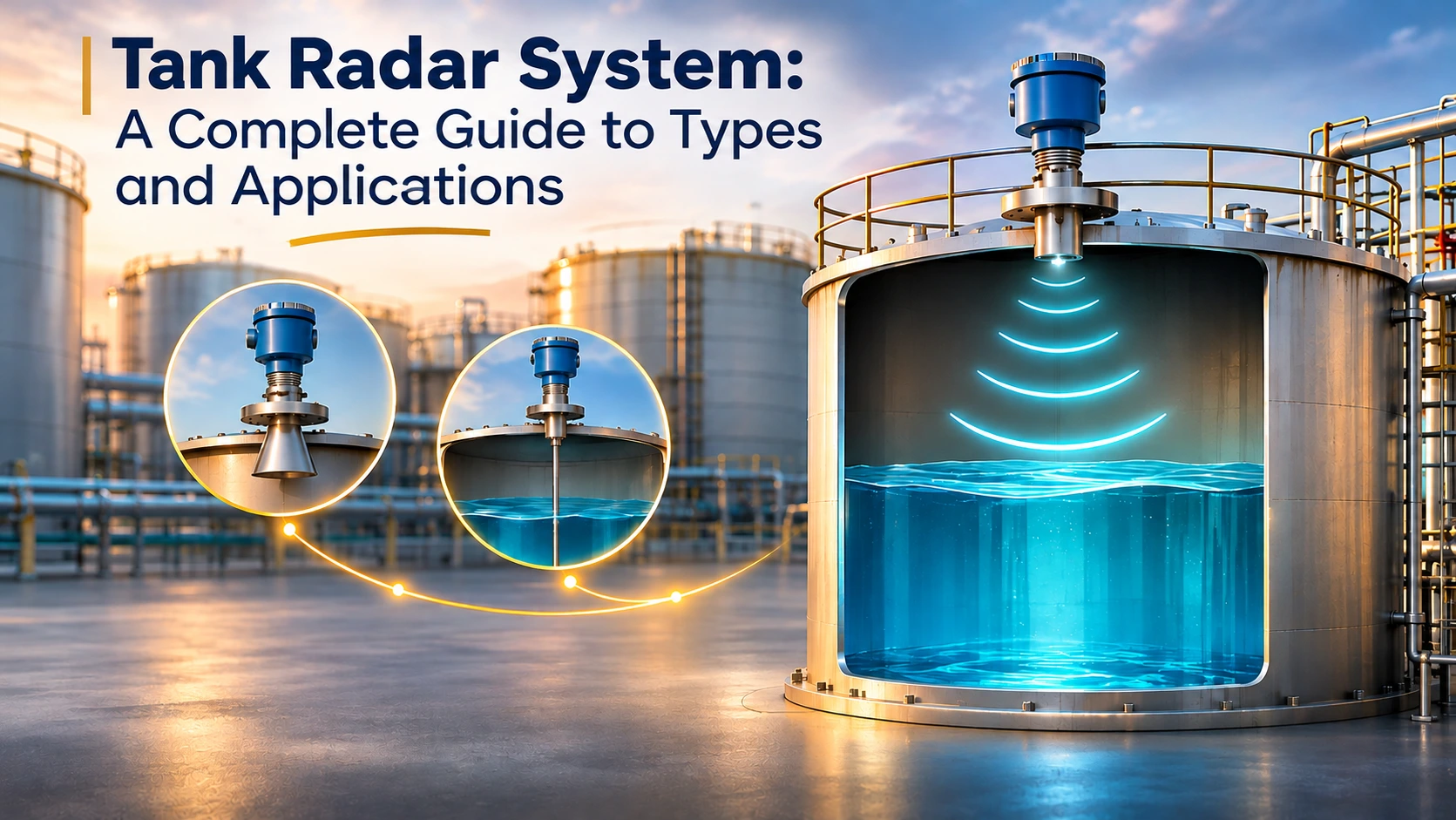
A radar instrument sends microwave signals towards the liquid surface. Part of the signal reflects to the antenna. The instrument analyses the reflection to calculate the distance between the antenna and the liquid, then uses the configured tank height to determine the level.
Pulse instruments calculate distance from signal travel time. Frequency-modulated continuous wave (FMCW) instruments use the frequency difference between transmitted and returning signals.
A typical installation contains four components: the transmitter generates microwave signals and processes returning reflections; the antenna directs signals towards the liquid and receives them; the signal processor calculates distance and converts it into a level reading; and the communication interface sends measurements to displays or connected monitoring equipment.
As a vessel consumes fuel, the distance between the surface and antenna increases. The instrument detects the change and updates the reading.
Operators should distinguish between level and ullage. Level measures the liquid height from a defined reference point. Ullage measures the empty distance between the liquid surface and the tank’s upper reference point. Depending on its configuration, the instrument can report either value.
Understanding Different Radar Measurement Technologies
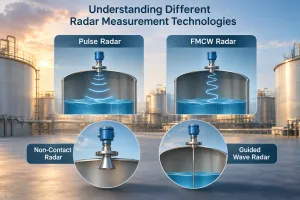
A tank radar system may use pulse radar or FMCW technology. Both rely on microwave signals, but calculate distance differently. Pulse radar sends short bursts of microwave energy towards the liquid. The antenna receives the reflected signal, and the instrument calculates distance based on the time it takes for the signal to return. It suits many storage and process applications, within the instrument’s specified operating limits.
FMCW radar transmits a continuous signal whose frequency changes over time. The instrument compares the returning signal with the transmitted signal and uses the frequency difference to calculate distance. It is used in high-accuracy gauging, including large storage tanks.
Radar instruments also differ in how they direct signals:
- Non-contact radar: An antenna above the tank measures the liquid surface without a probe entering the product.
- Guided wave radar: Microwave energy travels along a probe or cable. It may suit tanks where geometry or process conditions make free-space measurement difficult.
Non-contact equipment avoids product contact. Guided wave instruments may suit selected tanks with turbulence, foam, or restricted mounting space. The choice depends on the liquid and tank internals.
Factors That Affect Radar Sensor Accuracy
A radar level sensor used in a tank radar system must distinguish reflections from the actual liquid surface from signals returning from pipes, ladders, heating coils and other internal structures. These unwanted reflections, known as false echoes, can affect readings if the instrument is installed too close to an obstruction.
Antenna design helps manage interference. Horn antennas suit many standard liquid applications, while parabolic antennas focus the signal into a narrower beam to reduce reflections from nearby structures. Compact arrangements may suit restricted mounting spaces.
The stored liquid matters too. Materials with a low dielectric constant may produce weaker reflections. Heavy foam can make it harder to identify the actual surface, while condensation or product deposits on the antenna may affect signal quality.
Before selecting a radar level transmitter, engineers should check liquid properties, tank dimensions, measuring range, antenna arrangement, and operating conditions. An accuracy figure alone cannot show whether an instrument will perform reliably in a particular installation.
Industrial tank radar system Applications
Industrial facilities store liquids under varying process conditions. Refineries may hold crude oil, diesel, and other petroleum products. Chemical plants handle solvents, acids and process liquids, while water treatment facilities monitor reservoirs, treatment vessels and wastewater systems.
An Industrial tank radar system measures these liquids without placing the instrument directly into the stored material. This is useful where manual checks are difficult, frequent readings are required, or product contact is undesirable. The equipment must still suit the liquid, temperature, pressure, and safety requirements.
Oil and gas facilities track product levels and storage capacity. Chemical manufacturers monitor solvents and corrosive process liquids, while food and beverage sites use suitable instruments that meet hygiene requirements.
A tank level radar system can send tank readings to a central interface. at a fuel terminal, this helps operators check available capacity before another delivery is transferred, reducing the risk of overfilling.
Managing Measurements for Tank Inventory
A tank radar system in a large storage installation may need to provide more than liquid height. Operators may also require ullage, product temperature, calculated volume and, in some applications, the position of an interface between two liquids.
A radar tank gauging system combines level instruments with suitable sensors, communication equipment and monitoring software. These measurements support different aspects of tank management:
| Measurement | What it tells operators | Practical application |
| Liquid level | Height of the stored product | Tracks the level inside the tank |
| Ullage | Empty distance above the liquid | Supports loading and capacity checks |
| Temperature | Product temperature from connected sensors | Supports volume correction |
| Interface level | Boundary between two liquid layers | Monitors separated products |
| Calculated volume | Estimated quantity based on tank data | Supports inventory management |
| High-level alarm | Whether a configured limit has been reached | Alerts staff during filling |
Radar measures distance to the liquid surface, not total tank volume. Volume calculations need tank geometry, calibration tables and, where relevant, product temperature. Interface and temperature readings need supporting instruments. Tank radar level measurement should therefore be assessed as part of the complete installation, with a clear distinction between direct readings, calculations and additional sensors.
Accurate tank measurement also plays a role in safe storage operations. The UK’s Health and Safety Executive (HSE), in its guidance on storing flammable liquids in tanks, recommends suitable measurement arrangements, with testing and calibration at installation and regular intervals. These checks help maintain measurement accuracy and support safer tank management.
Marine Tank Gauging System Applications
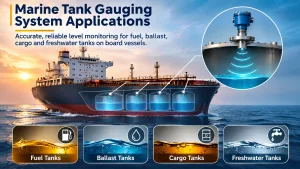
On a vessel, radar equipment faces different measurement conditions from instruments in a stationary industrial facility. Tanks experience movement, vibration and changing liquid conditions throughout a voyage. A marine tank gauging system helps crew members monitor onboard storage, with equipment selected for the vessel type, tank arrangement, and liquid being measured.
Fuel readings help engineers track supplies, review consumption and plan bunkering. Ballast levels also need monitoring because their distribution affects vessel stability, trim and draught.
Oil tankers and chemical carriers use cargo measurements during loading and discharge. Equipment materials and approvals must suit the cargo. Crew members also monitor freshwater supplies to plan replenishment, particularly on longer voyages.
Vessel movement can cause liquid to slosh and the surface to fluctuate even when the total quantity has not changed. Filtering can stabilise readings, but excessive filtering may delay genuine level changes.
A suitable marine tank radar system must meet vessel installation and environmental requirements, including applicable classification and hazardous-area approvals.
Connecting Instruments to Automation Systems
A tank radar system is useful only when operators and connected systems can access its measurements. A tank level monitoring system links field instruments with displays, control panels, and vessel or facility automation equipment.
On a cargo vessel, a central interface lets the crew compare tank readings across different sections. Industrial sites can bring measurements from multiple storage tanks into a control room.
Communication options depend on the equipment. Some instruments support HART, Modbus, or other manufacturer-supported interfaces. Engineers should confirm compatibility with the receiving control system, along with power requirements, cable routing, and the existing automation architecture.
Operational monitoring is not the same as independent safety protection. A standard level instrument is not automatically an overfill prevention device; a safety function requires equipment specifically designed and installed for that purpose.
A radar level measurement system needs correct configuration at both ends. Incorrect scaling, communication settings, or tank data can distort the central reading. Commissioning should verify the field measurement and the value received by the monitoring system.
Selecting Equipment for Real Operating Conditions
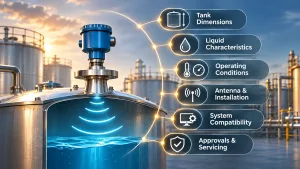
The highest-priced instrument is not necessarily the right choice. Start selection with the tank design, stored liquid, and operating conditions. A tank radar system that performs well in a stationary water tank may not suit a vessel carrying a volatile product or a process tank with heavy foam.
Review these factors before purchasing:
- Tank dimensions: Confirm tank height, measuring range, nozzle size, and mounting space. Check for blind zones near the top or bottom.
- Liquid characteristics: Identify the product and consider its dielectric properties, foam formation, and tendency to create deposits.
- Operating conditions: Check temperature, pressure, vapour, turbulence, and condensation. Confirm that the instrument supports actual process conditions.
- Antenna and installation: Review internal obstructions, nozzle arrangement and nearby structures. The antenna needs a suitable signal path to the liquid.
- System compatibility: Confirm communication protocols, power requirements, and output options for existing displays or automation systems.
- Approvals and servicing: For marine installations, check relevant classification, hazardous-area and environmental requirements. Consider inspection access, spare parts and technical support.
Before ordering, discuss tank drawings, product details and operating conditions with the supplier. Confirm whether the supply includes the transmitter, antenna, mounting accessories and commissioning support. Although radar instruments have no moving measuring parts, deposits, damaged connections, and incorrect settings still require attention. For marine operations, compatible spares and technical support can reduce downtime.
Conclusion: Improving Accuracy Across Operations
Radar technology allows marine vessels and industrial facilities to monitor stored liquids without direct contact between the measuring instrument and the product. From pulse and FMCW technologies to integrated gauging arrangements, a tank radar system provides continuous level information when the instrument, antenna, and installation suit the application. Complete inventory management may also require tank calibration data and additional sensors.
For marine automation, navigation equipment, and tank monitoring requirements, contact SACRED International to discuss your application. Share your vessel or facility requirements to explore suitable instrumentation and automation solutions.
Frequently Asked Questions About Tank Radar
1. What is the main purpose of a tank radar system?
A tank radar system measures the distance between an instrument and the liquid surface, converting it into a level reading. Operators use this information to monitor storage capacity, manage inventory, and plan transfers.
2. Can radar instruments measure different liquids?
Yes. A tank radar system can measure water, fuels, oils and chemicals, provided the selected model suits the application. Liquid properties, foam, vapour and temperature all influence measurement performance.
3. What is the difference between radar and ultrasonic measurement?
Unlike ultrasonic instruments, which use sound waves, a tank radar system uses electromagnetic microwave signals. Radar is generally less affected by changes in gas composition and temperature, although suitability depends on operating conditions.
4. Why does antenna selection matter?
The antenna controls how signals travel into the tank and return to the instrument. On a tank radar system, its design influences beam direction, signal strength, and interference from internal structures.
5. Can radar gauges work on moving ships?
Yes. A marine tank radar system can monitor liquid levels aboard moving vessels. However, tank geometry, liquid movement, antenna position, and instrument settings must suit the vessel’s operating conditions.
6. How often does radar gauging equipment need maintenance?
Although a tank radar system has no moving measuring parts, it still needs routine inspection. Checks should follow manufacturer recommendations and cover antenna deposits, electrical connections, configuration settings, and measurement performance.