
A ship navigating through fog cannot rely on visual observation alone. The bridge team still needs to monitor approaching vessels, identify nearby coastlines, and judge whether another object could affect the planned route. A ship radar system provides information that may not be available through the windows.
Radar has been part of marine navigation for decades, but the equipment found on modern vessels is far from a simple detection screen. Current systems offer target tracking, improved signal processing, and connections with other bridge equipment. Their capabilities vary considerably between models.
For shipowners and marine engineers, the choice involves more than selecting a display or antenna. Frequency, installation position, compatibility, maintenance support, and operating conditions all influence how well the equipment performs. These details matter whether a vessel needs a new installation or a replacement for an ageing unit.
The Working Principle Behind Marine Radar
The ship radar working principle relies on the reflection of radio waves. An antenna transmits electromagnetic energy towards the surrounding area. When the signal encounters an object, such as a vessel or coastline, some of its energy may return to the antenna.
The radar calculates distance by measuring the time between transmission and reception. It determines bearing from the antenna’s direction when the echo arrives. The equipment then displays the information, usually as targets around the vessel’s position.
A navigator can select different range scales depending on the situation. A shorter scale helps examine nearby traffic, while a wider view shows objects farther away. Gain and clutter controls affect how clearly echoes appear, operators should adjust them carefully
Consider a vessel approaching a harbour entrance. The radar may show a breakwater, a ship moving across the entrance and another target approaching from astern. The officer can monitor their relative positions and movement instead of relying entirely on visual identification.
There are limits to what the equipment can detect. A large steel vessel will often produce a stronger echo than a small fibreglass boat. Low-floating objects may be difficult to distinguish from wave returns. Rain, sea conditions, target orientation and the antenna’s height also influence detection.
This is why radar information needs interpretation. A target appearing on the screen does not automatically reveal its identity or intentions. The bridge team must assess its movement and compare the display with visual observations, charts, and other navigational information.
Types of Marine Radar System and Their Technologies
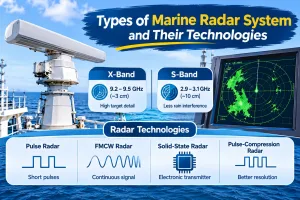
The types of marine radar used for navigation differ mainly in operating frequency and transmitter technology. X-band and S-band are the two principal frequency bands used on commercial vessels.
X-band operates between approximately 9.2 and 9.5 GHz, with a wavelength of around 3 cm. Its shorter wavelength provides good target discrimination. This is useful when navigating close to other vessels, monitoring smaller targets, or working in confined waters. Heavy rain, however, can weaken its signals.
S-band operates between approximately 2.9 and 3.1 GHz, with a wavelength of around 10 cm. It generally experiences less rain attenuation than X-band. This characteristic can be useful on routes where heavy precipitation regularly affects radar performance.
Some commercial vessels carry both bands. The two provide different detection characteristics, allowing officers to compare information when weather or traffic conditions make one display less useful.
The ship radar system may also be classified according to its transmission method or transmitter design:
- Pulse radar: Sends short bursts of radio-frequency energy and calculates distance from the time taken for echoes to return.
- FMCW radar: Transmits a continuous frequency-modulated signal and uses the returning signal to determine target distance and movement.
- Solid-state radar: Uses electronic transmitter components rather than a conventional magnetron. Depending on the design, it can reduce maintenance demands and extend component life.
- Pulse-compression radar: Uses coded pulses and signal processing to improve range resolution.
These descriptions should not be confused. X-band and S-band refer to operating frequencies, while solid-state describes transmitter technology. Buyers comparing radar specifications need to understand which characteristic each term describes.
Essential Components Used in Marine Radar
The reliability of a ship radar system depends on more than its display. Several components handle signal transmission, reception, and processing. A problem in any one of them can affect the information available to the navigator.
| Marine Radar Component | Main Function |
| Antenna or scanner | Transmits radar signals and receives returning echoes. |
| Transmitter | Generates the radio-frequency energy used for detection. |
| Receiver | Detects and amplifies returning signals. |
| Duplexer | Allows the antenna to switch between transmission and reception. |
| Signal processor | Processes echoes and filters unwanted signals. |
| Display unit | Presents detected targets and navigational information. |
| Control unit | Allows operators to adjust range, gain and clutter settings. |
| Power supply | Provides electrical power to the equipment. |
Installing a ship radar system requires careful attention to the scanner’s position. A mast, funnel or crane may obstruct part of the antenna’s scanning area, creating a shadow sector where approaching targets become difficult to detect. Engineers should identify these obstructions before finalising the installation.
Electrical connections also need regular attention. Salt and moisture can damage exposed connectors, while vibration may loosen fittings over time. Damaged cables can cause intermittent signals, receiver faults may produce weak echoes, and incorrect heading input can affect target bearing alignment.
Understanding individual marine radar components helps engineers narrow down the source of a fault. Replacing the complete installation is not always necessary; the problem may involve a single connection or unit.
Marine Radar Applications Across Vessels
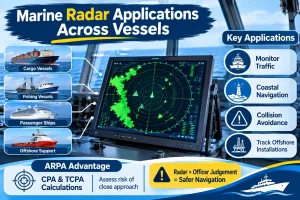
The range of marine radar applications depends on the vessel’s work and operating area. A cargo ship on an ocean passage does not face the same navigational conditions as a fishing vessel working near a coastline.
In a busy shipping lane, officers use radar to monitor vessels approaching from different directions. This is particularly useful where ships cross, overtake or change course within a limited area. Tracking selected targets gives the bridge team information for assessing potential close-quarters situations.
Coastal navigation presents another challenge. Radar can show echoes from land features, harbour walls, breakwaters and other fixed structures. Officers may use these returns to check their surroundings and assess distances from hazards. They should still verify their position using appropriate charts and other navigational methods.
The ship radar system serves different operational requirements across vessel categories:
- Cargo vessels: Monitor surrounding traffic, coastlines and hazards during ocean passages and port approaches.
- Fishing vessels: Observe nearby vessels, coastlines and certain surface targets while working offshore or in coastal waters.
- Passenger ships: Monitor traffic while navigating busy ports, channels and restricted waters.
- Offshore support vessels: Track nearby installations, service vessels, and other traffic around offshore operations.
Collision avoidance is another major use. Automatic Radar Plotting Aid (ARPA) can track selected targets and calculate their Closest Point of Approach (CPA) and Time to Closest Point of Approach (TCPA). These figures help officers assess whether another vessel may pass too close.
ARPA calculations depend on correct target acquisition, adequate tracking time, and reliable sensor inputs. They do not replace the officer’s judgement or the International Regulations for Preventing Collisions at Sea (COLREGs). Radar remains one part of the wider ship navigation system.
Selecting Modern Marine Radar Equipment
Choosing a ship radar system requires an understanding of the vessel’s routes, operating conditions and existing bridge equipment. A coastal workboat, for instance, may have different requirements from a cargo vessel travelling through busy international shipping lanes. These differences should guide your equipment choice.
Before comparing ship radar equipment, consider the types of marine radar available. x-band offers good target discrimination, while s-band generally performs better in heavy rain. Understanding the ship radar working principle also helps buyers see how weather, target size, and antenna position affect detection.
The condition and arrangement of marine radar components deserve equal attention. Antenna placement, scanner clearance, cable connections, and display compatibility can affect performance after installation. On larger vessels, these factors also affect how effectively radar systems on ships exchange information with other bridge equipment.
Modern marine radar technology offers features such as solid-state transmission, pulse compression, and improved target processing. Depending on the equipment, these capabilities can support more detailed target information and reduce certain maintenance requirements. However, assess the benefits against the vessel’s actual operating needs.
Integration is another purchasing consideration. Marine navigation radar may share information with AIS, ECDIS, and heading sensors as part of a wider ship navigation system. These connections help navigators compare different sources of information without treating them as interchangeable.
The choice should also reflect the vessel’s marine radar applications, whether that involves port approaches, offshore operations, coastal navigation or long-distance voyages. Different marine radar system configurations offer different capabilities, so buyers should check technical specifications, regulatory requirements, spare-parts availability, and after-sales support before deciding.
Maintaining Reliable Ship Radar Performance
Salt, moisture and vibration are part of everyday marine operations. Over time, they can affect a ship radar system, particularly around the scanner, mounting hardware and exposed electrical connections.
A maintenance schedule should include inspections of the antenna, mounting arrangements, cables and connectors. Engineers should look for corrosion, water ingress, loose fittings and physical damage. The manufacturer’s maintenance instructions and the vessel’s operating conditions should determine inspection intervals.
Operational checks can reveal faults that are not obvious during a visual inspection. The crew should confirm that the equipment starts correctly, the antenna rotates as expected, and the display receives information without interruption.
The symptoms often provide a starting point for investigation. Weak or missing echoes may indicate a problem with the antenna, receiver, or signal path. Intermittent operation could point towards an electrical connection or power supply issue. Unusual scanner noise may require inspection of its drive assembly.
Maintenance records become especially useful when the same fault returns. Recording when a problem occurs, the conditions at the time, and any previous repairs gives technicians better diagnostic information.
Repairs should follow the manufacturer’s procedures and be carried out by appropriately qualified personnel. High-voltage components and rotating scanner assemblies present safety risks when handled incorrectly.
Replacement parts need to match the equipment specifications. An unsuitable component may introduce compatibility or performance problems. For vessels operating far from major service centres, planning the availability of appropriate spare parts can reduce the time equipment remains out of service.
Ship radar maintenance should also take account of recognised maritime performance standards. The International Maritime Organization’s Resolution MSC.192(79) on radar equipment sets out performance standards for shipborne radar, including target detection, display and operational requirements. Ship operators should consider these standards when assessing equipment performance and planning maintenance.
Conclusion: Choosing the Right Radar Equipment
A ship radar system is an important source of navigational information, but its performance depends on the entire installation. Frequency selection, antenna position, component condition, and compatibility with other bridge equipment all deserve attention. The crew must also understand what radar can and cannot detect.
SACRED International supplies marine automation systems, navigation equipment, and ship spare parts to the global maritime industry. Contact the team to discuss your vessel’s navigation equipment requirements, replacement parts, and technical needs.
FAQ About Ship Radar System
1. What is the main purpose of a ship radar system?
A ship radar system detects nearby vessels, coastlines, and other objects using radio waves. It helps navigators monitor traffic, assess distances, and identify potential hazards when visibility is restricted.
2. What are the two main types of marine radar?
The two commonly used frequency bands in a ship radar system are X-band and S-band. X-band offers good target discrimination, while S-band generally experiences less signal attenuation in heavy rain.
3. How far can marine radar detect objects?
The detection range of a ship radar system depends on antenna height, equipment specifications, target size, and weather conditions. The radar horizon also limits how far surface objects can normally be detected.
4. What is the difference between radar and AIS?
A ship radar system detects objects through reflected radio waves, whereas AIS receives information transmitted by equipped vessels. Radar can detect objects without AIS, making both systems complementary sources of navigational information.
5. Why do ships use both X-band and S-band radar?
A ship radar system fitted with both bands offers different detection characteristics. x-band provides good target discrimination, while S-band generally performs better in heavy rain.
6. How often should marine radar equipment be maintained?
Maintenance intervals for a ship radar system depend on the manufacturer’s instructions, vessel operating conditions, and planned maintenance schedule. Regular inspections and operational checks help identify faults before they affect navigation.