
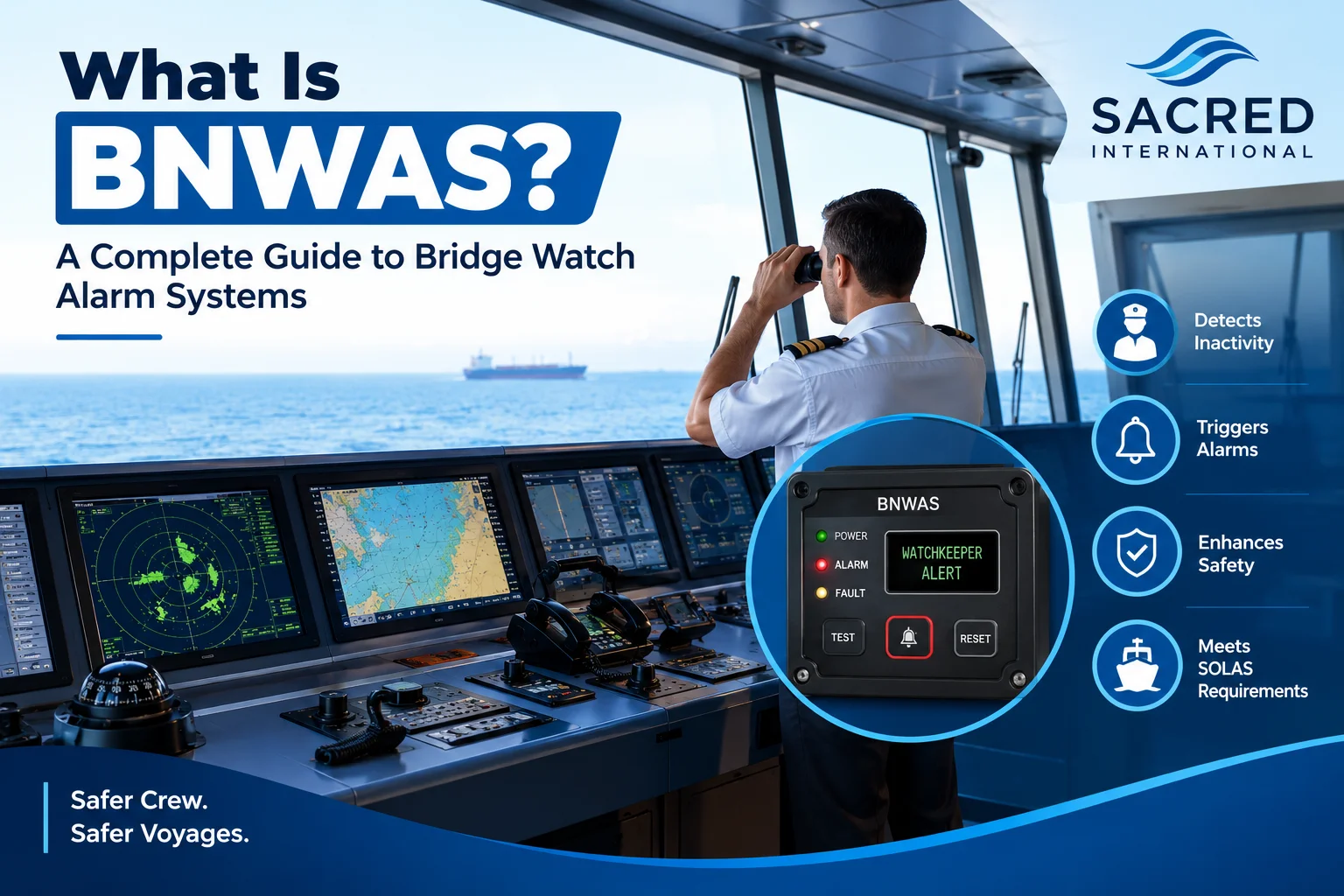
A ship can have radar, ECDIS, AIS and other navigation equipment operating normally while the person monitoring them suddenly cannot respond. A BNWAS system adds another layer of protection to this human element of navigation.
Consider a container vessel approaching a busy port before sunrise. Heavy rain cuts visibility, radar traffic increases, VHF communication is active, and the officer on watch handles several tasks at once. If that officer can no longer continue the watch, the navigation equipment will not necessarily recognise the problem.
That is where a bridge watch alarm system has a specific role. It checks for the expected response from the Officer of the Watch (OOW) and escalates an alert when that response does not come. This guide covers how the technology works, its components, IMO requirements, practical shipboard situations, common installation issues and factors to consider when selecting equipment.
How Does The Bridge Alarm Operate?
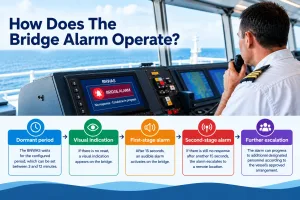
The BNWAS system uses staged alerts instead of immediately sending an alarm throughout the vessel. This allows the OOW to respond before the warning reaches another qualified person.
Under the IMO performance standard, the dormant period can be set between 3 and 12 minutes. If there is no appropriate reset at the end of that period, the sequence begins.
| Alarm Stage | What Happens |
| Dormant period | The BNWAS waits for the configured period, which can be set between 3 and 12 minutes. |
| Visual indication | If there is no reset, a visual indication appears on the bridge. |
| First-stage alarm | After 15 seconds, an audible alarm activates on the bridge. |
| Second-stage alarm | If there is still no response after another 15 seconds, the alarm escalates to a remote location. |
| Further escalation | The alarm can progress to additional designated personnel according to the vessel’s approved arrangement. |
The reset arrangement is an important part of BNWAS operation. It should be accessible during normal bridge work and positioned to prevent accidental activation.
BNWAS Meaning In Real Shipboard Situations
Take a bulk carrier making a night passage on relatively calm water. Traffic is limited, and the bridge has remained quiet for several hours. A sudden medical problem leaves the OOW unable to continue. Radar, ECDIS and other equipment may keep working, but the bridge has lost the person responsible for responding to changing conditions.
Now consider a vessel approaching a congested harbour during intense tropical rainfall. Outside visibility is poor, radar interpretation becomes more important, VHF traffic increases and several targets require attention. The alarm does not measure rainfall or workload, but it provides a defined escalation path if the OOW stops responding.
The technology therefore monitors bridge activity and response. It does not diagnose fatigue, illness, weather conditions or workload. In these situations, the BNWAS system provides a defined response mechanism when the expected watchkeeper response is missing.
Key BNWAS Functions On Ships
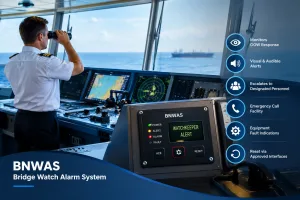
The BNWAS system supports several functions related to watch monitoring, indications, alarm escalation and assistance.
- Monitoring the OOW’s response during the configured watch period.
- Providing visual and audible indications on the bridge.
- Escalating an unanswered alarm to designated personnel.
- Providing an emergency call facility where fitted.
- Indicating relevant equipment malfunctions.
- Accepting suitable reset signals from approved interfaces.
- Supporting the operational modes required for the installation.
Reset controls deserve particular attention during bridge design.
A control placed too far from the OOW’s normal working position may make routine use inconvenient. A control located where accidental activation is easy can weaken the purpose of the monitoring arrangement.
For a vessel with several bridge consoles, wing positions, or an integrated bridge system, consider the equipment around actual watchkeeping practices rather than installing it wherever panel space is available.
What Are BNWAS Components And Interfaces?
A typical installation can include a main control unit, bridge operating controls, reset devices, visual indicators and audible alarm units. Depending on the arrangement, it may also include remote panels, emergency call controls and interfaces with other bridge equipment.
This becomes particularly important during a retrofit. An older vessel may have limited console space, existing alarm circuits and navigation equipment from several manufacturers. Replacing the alarm unit without reviewing those connections can create avoidable integration problems with the BNWAS system.
The aim is not simply to pass an initial functional check. It should remain practical and dependable throughout normal vessel operations.
BNWAS IMO Requirements For Ships
The BNWAS system must be considered alongside SOLAS Chapter V and the performance standards set out in IMO Resolution MSC.128(75). For the latest navigation and safety requirements, operators can refer to the International Maritime Organization (IMO) guidance when reviewing vessel-specific requirements.
The IMO performance standard describes three operational modes: Automatic, Manual ON and Manual OFF.
An important detail concerns Automatic mode. IMO guidance states that this mode should not be used on ships subject to SOLAS V/19.2.2.3, because that regulation requires the equipment to remain in operation whenever the ship is underway at sea.
The vessel’s flag-state requirements, classification requirements, statutory obligations, equipment approval and installation arrangement should therefore be checked before procurement.
BNWAS Performance Standards And Testing
Assess the equipment as a complete installation rather than simply as a control panel. IMO Resolution MSC.128(75) establishes the performance standards, while IEC 62616 specifies minimum performance requirements, technical characteristics, testing methods and required test results for this type of equipment.
This matters after dry-dock work. Suppose a vessel has undergone electrical maintenance and the main alarm panel still operates normally. A remote alarm connection could nevertheless have been disturbed while another system was being serviced. A panel-level check would not necessarily expose that problem.
Assess the BNWAS alarm system as a complete alarm path, from the initial bridge indication through to every designated response point, while the BNWAS system continues to meet its intended function.
How Weather And Workload Affect Watchkeeping?
A BNWAS safety system does not measure weather, visibility or workload, but these conditions can change the environment in which watchkeeping takes place.
During a coastal approach, an OOW may move between radar, ECDIS, visual lookout and communications within minutes. Heavy rain can reduce outside visibility, while darkness can increase dependence on electronic navigation information.
Tropical operations can bring intense rainfall, high humidity and salt-laden air. These conditions make equipment location, enclosure protection and maintenance important considerations. In colder regions, low temperatures, reduced daylight and rough seas can create a different working environment.
A quiet bridge and limited traffic do not remove the need for an effective navigational watch. The equipment must still provide its intended alarm sequence if the officer stops responding.
Environmental conditions influence the bridge environment, while the BNWAS system provides a defined response mechanism within that environment.
What Problems Can Occur Onboard?
A BNWAS only provides its intended protection when the complete installation works correctly. Some problems may appear during everyday operation rather than during initial commissioning.
Reset controls may be awkwardly positioned for the OOW, while remote alarms may be difficult to recognise from designated locations. Incorrect operating-mode configuration can create another issue, particularly when equipment is replaced without reviewing the vessel’s regulatory requirements.
Other practical concerns include poor understanding of reset procedures, disturbed connections after bridge modifications, incomplete testing after electrical maintenance and equipment installed in an unsuitable environmental location.
Consider a vessel that undergoes a bridge upgrade. The reset control still operates electrically, but its new position is inconvenient during normal watchkeeping. The equipment may function correctly from a technical perspective, but the installation may become less practical for the person using it.
A proper review of the BNWAS system should therefore consider both technical performance and how effectively the installation supports the OOW during normal watchkeeping.
Choosing A Right BNWAS Marine System
Choosing a BNWAS system should start with the vessel’s operating environment and bridge arrangement.
A new-build project allows the alarm system to be considered alongside the bridge layout, navigation equipment and cabling from the beginning. A retrofit has different constraints because existing panels, wiring, interfaces and available space may already be fixed.
Before selecting equipment, operators should consider regulatory compliance, bridge layout, environmental conditions, alarm coverage, system integration, maintenance access and retrofit limitations.
Operators should also assess environmental exposure carefully. Temperature, humidity, vibration, moisture and salt exposure can vary significantly between an enclosed wheelhouse and an exposed bridge-wing location.
For fleet operators managing different vessel generations, the same equipment specification may therefore require different installation approaches from one ship to another.
BNWAS On Ships: Maintenance And Use
The equipment’s effectiveness continues after installation. Crew members need to know the actual alarm sequence, reset arrangement, operating mode and response procedure used on their vessel.
Routine inspection should follow the manufacturer’s instructions and the vessel’s planned maintenance procedures. Check relevant alarm stages, reset points, remote panels, power arrangements, and connected interfaces according to applicable procedures.
Crew familiarisation is equally important. A newly joined officer may understand the purpose of the equipment but still be unfamiliar with the specific alarm tone, reset location or remote escalation arrangement onboard. Familiarisation should therefore cover the equipment actually installed on the vessel.
The same applies after dry docking, bridge upgrades and electrical modifications. Changes around the alarm chain provide a reason to confirm that every stage still operates correctly and that the BNWAS system remains ready for its intended role.
A useful maintenance question is not simply, “Does the panel turn on?” It is: If the OOW does not respond, will every intended alarm reach the right person?
Conclusion
A BNWAS bridge safety system addresses a specific gap in bridge safety: electronic navigation equipment can continue operating even when the officer responsible for monitoring it cannot respond. By providing a defined sequence of indications and escalating alarms, the BNWAS system gives the bridge team an additional safeguard during night passages, poor visibility, heavy weather, congested approaches and long watches. Its effectiveness depends on correct configuration, proper installation, thorough testing, and crew familiarity.
If you are planning a new installation, equipment replacement or bridge retrofit, contact SACRED International for marine automation systems, navigation equipment and ship spare parts designed to support demanding maritime operations worldwide.
Frequently Asked Questions
1. What Does BNWAS Stand For?
BNWAS stands for Bridge Navigational Watch Alarm System. A BNWAS system monitors bridge activity and provides staged visual and audible indications when the Officer of the Watch does not respond within the configured period.
2. What Is The Main Purpose Of BNWAS?
The main purpose of the BNWAS system is to identify possible operator disability during the navigational watch and alert other qualified personnel. It adds a safety layer without replacing professional watchkeeping or navigation procedures.
3. How Long Is The BNWAS Dormant Period?
The IMO performance standard permits the dormant period to be set between 3 and 12 minutes. During this period, the BNWAS system waits for the required response before beginning its visual and audible alarm sequence.
4. Is BNWAS Mandatory On Ships?
Applicable SOLAS requirements specify BNWAS carriage for relevant ships according to vessel type and size. Ships subject to the applicable requirement must keep the BNWAS system operating whenever they are underway at sea.
5. Can BNWAS Work With Bridge Equipment?
Yes. Depending on the approved equipment and installation, a BNWAS system can receive suitable reset signals from bridge equipment and provide interfaces with other systems. Integration should be properly engineered and tested.
6. What Standard Covers BNWAS Testing?
IMO Resolution MSC.128(75) establishes the performance standards, while IEC 62616 specifies minimum performance requirements, technical characteristics, testing methods and required test results. These standards help assess whether a BNWAS system performs as intended.