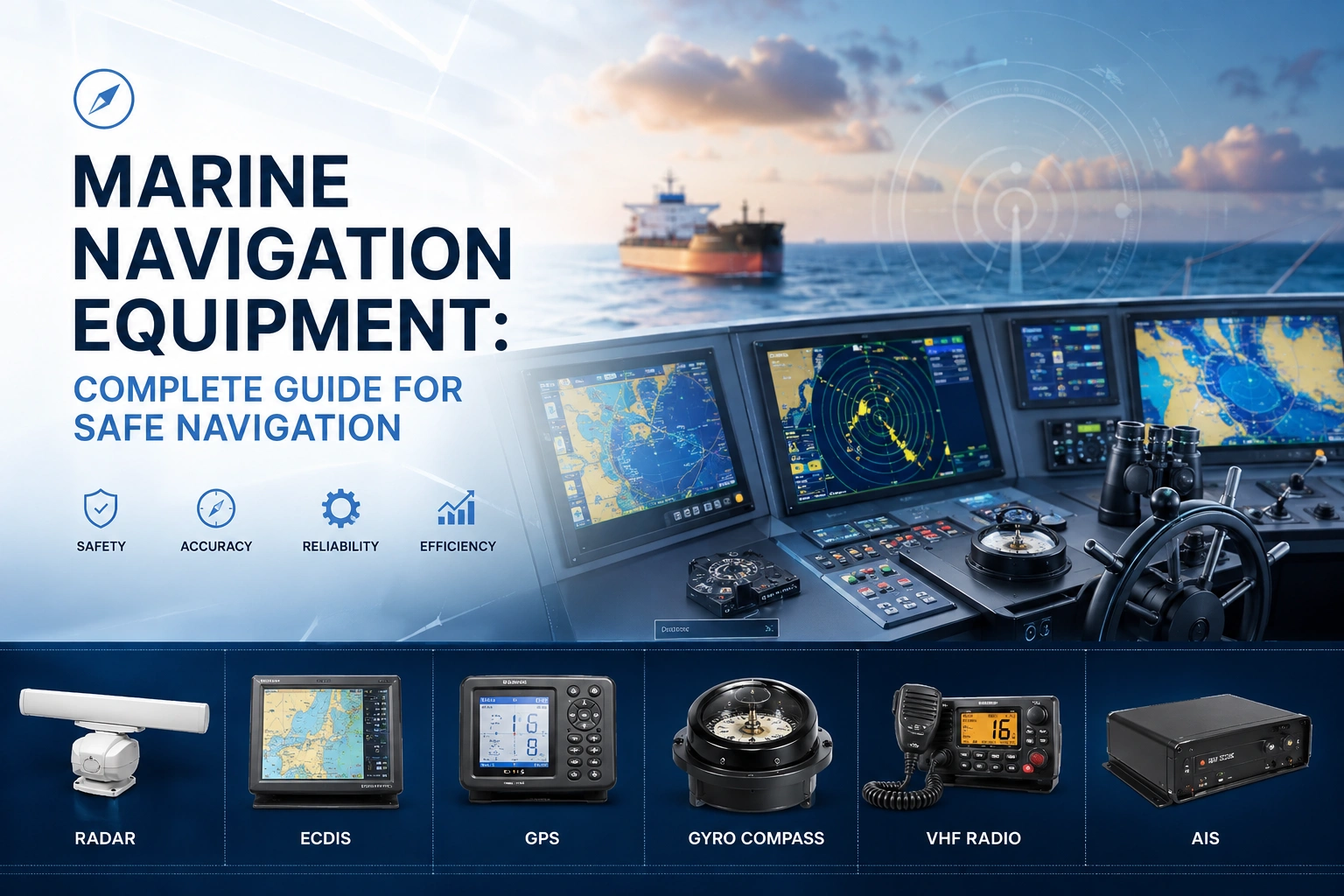
A cargo vessel is approaching one of the world’s busiest shipping lanes just before sunrise. Heavy rain has reduced visibility, nearby vessels appear and disappear through the mist, and changing tides demand quick decisions from the bridge team. In moments like these, marine navigation equipment becomes the difference between reacting to uncertainty and navigating with confidence.
Every delayed shipment affects someone, whether it is a manufacturer waiting for raw materials, a retailer expecting seasonal inventory, or an offshore platform relying on essential supplies. From container vessels crossing the Pacific to tankers operating through the Middle East, safe navigation keeps global trade moving despite changing weather, busy shipping corridors, and demanding delivery schedules.
Technology has transformed the bridge, but it has not replaced professional judgment. Today’s officers combine digital systems, practical seamanship, and continuous situational awareness to navigate safely through unpredictable weather, congested ports, and long ocean crossings. Understanding how these technologies work together helps shipowners, operators, and fleet managers make smarter investment decisions while protecting people, cargo, and the environment.
Why marine navigation equipment Matters
Ships rarely operate in ideal conditions. A vessel may leave port under clear skies and encounter dense fog, strong crosswinds, heavy swell, or tropical storms only hours later. These unpredictable environments challenge even experienced bridge teams, making marine navigation equipment an essential part of everyday operations rather than an optional investment.
Consider a fully loaded container ship approaching the Strait of Singapore during the monsoon season. Heavy rain, tidal currents, pilot boarding operations, and hundreds of nearby vessels require officers to monitor every movement carefully. Instead of relying on one display, they compare radar echoes, AIS targets, electronic charts, and communication updates before making even minor course adjustments.
Beyond safety, dependable ship navigation equipment also protects business performance. Missed arrival windows, unnecessary route deviations, higher fuel consumption, and avoidable downtime all increase operating costs. Investing in dependable navigation solutions helps shipping companies improve efficiency while supporting safer voyages throughout the year.
Modern Marine Navigation Systems
Today’s bridge functions as an integrated information hub rather than a collection of separate devices. Marine navigation equipment works together with connected technologies to provide a unified, clear operational picture for navigation officers, enhancing decision-making efficiency.
| System | Primary Role | Practical Advantage |
| marine navigation systems | Connect multiple onboard navigation technologies | Improves situational awareness and operational efficiency |
| marine GPS navigation | Determines the vessel’s precise position | Supports accurate route planning and tracking |
| marine radar systems | Detects nearby vessels, coastlines, and obstacles | Enhances collision avoidance in poor visibility |
| AIS navigation system | Shares vessel identity, position, and movement | Improves traffic awareness and navigational safety |
| ECDIS navigation system | Displays official electronic navigational charts | Simplifies voyage planning and route monitoring |
| marine communication equipment | Enables communication between ships and shore stations | Supports emergency response and operational coordination |
| integrated bridge systems | Combines navigation, communication, and monitoring systems | Helps bridge teams make faster, informed decisions |
Instead of functioning independently, today’s bridge technologies continuously verify one another. A GPS receiver confirms the vessel’s position; the ECDIS displays that location on electronic charts; radar identifies nearby targets regardless of visibility; and AIS provides identification and movement data for surrounding ships. This layered approach gives bridge officers greater confidence before changing speed or altering course.
This integrated approach reduces unnecessary workload and reassures bridge teams that multiple sources of information support their decisions, fostering confidence in navigation safety.
Marine Radar Systems Explained
Weather often changes faster than voyage plans. Heavy rainfall, sea fog, darkness, or rough seas can reduce visual awareness within minutes. In such situations, marine navigation equipment provides valuable support by enabling officers to monitor surrounding conditions even when visibility is limited.
Modern marine radar systems continuously detect nearby vessels, coastlines, floating objects, and weather patterns. Rather than replacing visual observations, radar strengthens situational awareness by confirming what officers may not immediately see from the bridge.
Its practical advantages include:
- Detecting approaching vessels during restricted visibility.
- Monitoring navigation in and around busy ports and narrow channels.
- Supporting collision avoidance decisions.
- Tracking weather cells that may affect planned routes.
- Assisting navigation during nighttime operations.
Professional bridge teams understand that every navigation system has limitations. Heavy rain may create radar clutter, satellite signals can occasionally be interfered with, and electronic charts require regular updates. Cross-checking information from multiple systems remains one of the strongest principles of modern navigation and aligns with internationally accepted bridge resource management practices.
Commercial Marine Navigation Systems
Global shipping has become more demanding than ever before. Tight delivery schedules, rising fuel prices, environmental expectations, and increasing insurance costs leave little room for operational inefficiency. In this environment, marine navigation equipment contributes directly to both safety and commercial performance.
Imagine two bulk carriers sailing similar transoceanic routes during cyclone season. One vessel relies on isolated onboard technologies, while the other operates with commercial marine navigation systems connected through an integrated bridge environment. The second crew can simultaneously evaluate updated weather forecasts, surrounding vessel movements, digital chart information, and voyage adjustments.
Lower fuel consumption is only part of the benefit. Better voyage planning also reduces the likelihood of missing allocated berthing windows, minimizes costly demurrage risks, improves schedule reliability, and helps operators manage rising operating expenses in an increasingly competitive shipping market.
This operational advantage becomes increasingly valuable as shipping companies seek to balance profitability with safe navigation and environmental responsibility.
Choosing Navigation Equipment Wisely
Selecting vessel navigation equipment should never depend only on purchase price. Every vessel operates differently, from coastal ferries and offshore support vessels to oil tankers and large container ships. Because operational requirements vary significantly, marine navigation equipment should be selected according to the vessel’s trading pattern, bridge configuration, and long-term operational goals.
Before making an investment, decision-makers should evaluate:
- Vessel type and operational profile.
- Expected weather and trading regions.
- Integration with existing onboard systems.
- Future software upgrades and scalability.
- Availability of worldwide technical support.
- Spare parts availability throughout the equipment lifecycle.
Many operators also evaluate whether new equipment complies with internationally recognized navigation performance standards and can integrate smoothly with future bridge upgrades. Choosing navigation equipment that aligns with applicable IMO performance standards and SOLAS Chapter V requirements helps support safer operations, regulatory compliance, and reliable vessel performance.
The most successful shipowners view navigation technology as a long-term operational investment rather than a short-term purchasing decision. Reliable equipment reduces unexpected downtime, supports regulatory readiness, and delivers greater value throughout years of continuous service.
Maritime Navigation Technology Evolution
The modern bridge has become a connected decision-making environment in which information arrives simultaneously from multiple onboard systems. During long ocean crossings, changing weather patterns, busy traffic separation schemes, and evolving voyage plans require officers to process accurate data without unnecessary delays. In this environment, marine navigation equipment supports informed decisions by presenting reliable information when every minute matters.
Imagine a vehicle carrier crossing the North Atlantic during winter after receiving updated weather forecasts predicting rapidly developing low-pressure systems. Instead of continuing along the original route, officers evaluate forecast models, electronic charts, nearby traffic, and wave conditions before selecting a safer passage. Although the alternative route adds distance, it reduces structural stress on the vessel, protects valuable cargo, and avoids unnecessary operational risks.
The industry is also moving toward smarter marine electronic navigation supported by satellite connectivity, predictive analytics, and real-time operational monitoring. These technologies strengthen situational awareness while allowing experienced bridge teams to make better-informed navigational decisions.
Integrated Bridge Systems Benefits
Modern ships generate enormous amounts of operational data every hour. When information remains scattered across separate devices, officers spend valuable time comparing displays before reaching conclusions. That is why marine navigation equipment increasingly operates through integrated bridge systems, bringing navigation, positioning, communication, alarms, and voyage planning into one coordinated environment.
The advantages become particularly noticeable during high-pressure situations.
- Faster interpretation of navigation information.
- Reduced workload for bridge officers.
- Better coordination between navigation and communication systems.
- Improved awareness during restricted visibility.
- More consistent operational decision-making.
- Easier monitoring during long international voyages.
This coordinated workflow is particularly valuable within Traffic Separation Schemes, restricted waterways, coastal approaches, and busy commercial ports, where navigation decisions often need to be made within seconds rather than minutes.
Integration also supports Bridge Resource Management principles by ensuring every officer has access to the same operational picture. Technology strengthens teamwork, but experienced human judgment remains the most important element of safe navigation.
Maintaining Navigation System Performance
Purchasing advanced equipment is only the beginning. Reliable ship safety navigation equipment depends on consistent inspection, calibration, software updates, and preventive maintenance throughout the equipment lifecycle. For this reason, marine navigation equipment should be viewed as an operational asset that requires continuous attention rather than a one-time installation.
Bridge teams routinely verify equipment functionality before departure, while technical personnel perform scheduled servicing to maintain accuracy and reliability. Electronic charts require timely updates, sensors need regular calibration, and communication systems must remain operational under varying sea conditions. Even minor issues can affect voyage planning if left unresolved.
Reliable spare parts remain essential throughout a vessel’s operational life. Even a short delay in replacing failed bridge equipment may affect sailing schedules, increase maintenance costs, and disrupt planned commercial operations. Working with dependable suppliers helps operators maintain consistent fleet availability while reducing unnecessary downtime.
Building Smarter Bridge Operations
As shipping becomes increasingly connected, vessel operators are focusing on building resilient bridge environments instead of simply installing new technology. Throughout this evolution, marine navigation equipment continues supporting safer operations by combining reliable hardware, intelligent software, and experienced human decision-making.
Rather than chasing every emerging innovation, many fleet operators prioritize technologies that improve cybersecurity, simplify maintenance, integrate with existing bridge infrastructure, and remain adaptable to future navigation standards. This practical strategy protects long-term investments while allowing crews to adopt new capabilities without disrupting established operating procedures.
The future of navigation will not depend on automation alone. Ships will continue relying on skilled officers who understand weather, traffic behavior, local regulations, and vessel handling while using advanced navigation technology as a dependable decision-support tool.
Conclusion
Safe navigation depends on preparation, reliable technology, experienced bridge teams, and informed operational decisions throughout every voyage. From unpredictable weather and congested shipping lanes to demanding commercial schedules, marine navigation equipment supports safer operations, improves voyage efficiency, and helps vessels navigate confidently under changing conditions.
Whether you need advanced navigation equipment for ships, marine automation systems, or genuine ship spare parts, contact SACRED International to discover reliable marine navigation solutions backed by global industry experience, dependable technical support, and products designed to support long-term vessel performance worldwide.
Frequently Asked Questions
1. Why is marine navigation equipment important for modern ships?
marine navigation equipment provides accurate positioning, route planning, traffic awareness, and communication support throughout a voyage. When combined with skilled bridge operations, these systems help reduce navigational risks, improve operational efficiency, and protect crews, cargo, and the marine environment.
2. How do integrated bridge systems improve vessel operations?
Integrated bridge systems combine navigation displays, communication equipment, positioning systems, alarms, and voyage planning into one coordinated platform. When integrated with marine navigation equipment, they improve situational awareness, reduce officer workload, support faster decision-making, and enhance operational safety during both routine and challenging voyages.
3. What factors should shipowners consider before purchasing marine navigation equipment?
Shipowners should evaluate vessel type, trading routes, expected weather conditions, compatibility with existing systems, maintenance requirements, spare parts availability, future scalability, and worldwide technical support, rather than focusing solely on the initial purchase price.
4. Can marine navigation equipment completely replace experienced bridge officers?
No. Modern navigation technology supports better decision-making, but experienced officers remain responsible for interpreting information, responding to changing conditions, communicating effectively, and applying sound seamanship during every stage of a voyage.
5. How often should marine navigation equipment be maintained?
Routine operational checks should occur before every voyage, while scheduled inspections, software updates, calibration, and preventive maintenance should follow manufacturer recommendations and company maintenance programs. Consistent servicing helps maintain reliability and reduces unexpected operational interruptions.
6. Why choose a trusted global supplier for marine navigation equipment?
An experienced global supplier provides dependable products, genuine spare parts, technical expertise, and ongoing support throughout the equipment lifecycle. This helps vessel operators maintain reliable performance, minimize downtime, and ensure navigation systems remain ready for demanding worldwide operations.